Real World Math
  • Home
  • Lesson Downloads
    • Concept Lessons
    • Measurement Lessons
    • Project Based Learning
    • Exploratory Lessons
    • Space Lessons
  • Videos
  • Tutorials
    • Google Earth Tutorials
    • Xtranormal Tutorials
    • HTML Layout Tutorials >
      • Introduction
      • The Basics
      • Layout Templates >
        • Cover page
        • Blogger HTML Formatting
        • Paragraphs w Image
        • Image w. bullets
        • Video
        • Split text & image
        • Complex table
      • More tips
  • Teachers
    • Lessons >
      • Concept Lesson Outlines >
        • Around the World...
        • Estimation
        • Exchange Rate
        • Line Graphs
        • Oil Spill Estimates
        • Planes of Greenland
        • Polyhedrons
        • Scientific Notation 1
        • Scientific Notation 2
        • Tessellations
        • Time Zone Problems
        • Volume of Solids
      • Measurement Lesson Outlines >
        • Intercept Theorem
        • Complex Area
        • Crop Circles
        • Estimating Distance
        • Fractal Coastline
        • Tsunami Warning
      • PBL Lesson Outlines >
        • Spreadsheet App
        • Community Building
        • Iditarod Challenge
        • SAR Project
        • SketchUp
        • Typhoon Project
        • U-Boat Hunt
        • Water Problems
      • Exploratory Lesson Outlines >
        • Crop Circles 2
        • Four Color Map
        • Line Patterns
        • Mazes & Labyrinths
        • Networks
        • Pyramid in the Desert
        • The Flat Earth
        • Whale Watch
      • Space Lesson Outlines >
        • Lunar Fieldtrip
        • Lunar Sports
        • Rockets
    • Blog
    • About the site
    • RWM Video Overview
  • Contact
Kmz Download
Teacher Downloads

No additional downloads
Concepts Used
Network Theory
Geometry
Spatial Reasoning
Deductive Reasoning
Inductive Reasoning
Problem Solving

Grade level
Grades 5-12

Subject Areas
Math

NCTM Standards
Geometry
Problem Solving
Reasoning and Proof
Connections
Representation
Technology

NETS*S
1a, 1c, 1d, 2b, 3a, 4a,
4b, 4d, 6b


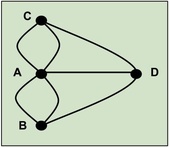
Network diagram


Picture
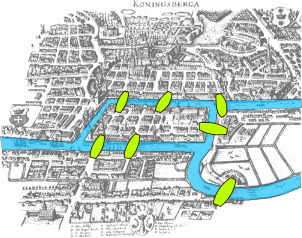
Konigsberg bridges - modified by Bogdan Giuşcă

Network Theory


Objectives
  • Draw consecutive paths without traversing any segment twice
  • Write rules for network solutions

Lesson Description

Network Theory investigations deal with how paths can be drawn in a continuous circuit.  
It is a topic considered to be a part of another theory named Graph Theory.  Both concepts come from a branch of geometry known as topology.  Topology is the study of how objects relate to one another in space and their properties when stretched or bent.  None of these topics would fall under what most people would consider to be traditional mathematics.  Nevertheless, they contain important mathematical ideas that can be applied to a multitude of other pursuits, such as science, computer science, and economics, to name a few.

The students will attempt to solve three types of network “puzzles,” such as the infamous Konigsburg Bridge problem, in Google Earth.  The first type of problems asks student to draw a path around a set of island obstacles, the second type are bridge problems, and the third type are tracing puzzles.  The objective for each problem is to draw a path that connects each point (or vertex)  in a sequence without repeating any segment (or edge) of the path.  Each set of problems gets increasingly difficult and some are unsolvable.  Almost all of the problems need to be solved in a certain way by carefully choosing the most efficient paths.


The overall goal of the activity is for students to make generalizations or rules on how these problems can be solved.  Why is it that some can be solved while others cannot?  It is intended to be a constructive learning exercise in that students make sense of the ideas on their own.  This is conveyed in the last placemark, Final Thoughts.  I would recommend having the students complete the Google Earth activity individually, but then have them work in pairs or small groups to write their conclusions.  This could be accomplished in a Google Doc or written on paper.  Rather than supply them with the correct terminology, it would be better to have the students try to describe the ideas in their own way. 

The key ideas involved are:
  • Paths can be drawn only if the the number of edges is odd for 0, 1, or 2 vertices.
  • If only one vertex has an odd number of edges, then you must start and end at that vertex.
  • If two vertices have an odd number of edges, then you must start on one and end on the other.
  • If three or more vertices has an odd number of edges, then the path cannot be drawn.

Additionally, the students are asked how these ideas can be applied in the world.  The nature of some of the problems, routes for instance, suggests one use.  Any transfer or flow between two points, be it money, mail, computer circuits, or plumbing, should be able to find a use of Network or Graph theories.


Note:  The grade level listed for this lesson goes all the way to 12th grade.  That is because Network and Graph Theory problems can become advanced topics with further investigation.  High school students can try to express the problems using vertex and edge graphs, or explore matrices or algorithms related to graph theory.


Here are some links for advanced study:
  • Graph Theory Tutorials by Chris Caldwell
  • MegaMath’s Graph and Graph Theory
  • Euler's Theorem - video by shaunteaches
  • Eulerian path - Wikipedia article

Powered by Create your own unique website with customizable templates.